

Centre for Research in Modern European Philosophy
CRMEP is an independent educational association based in London. We organize events, publications and study groups. We provide open access to a wide range of writing and lectures in post-Kantian philosophy and critical theory, including Marxism, feminism, psychoanalysis and the critique of the European tradition. Support the CRMEP
Events & Lectures
Lectures and seminars are free but registration is required.

CRMEP Public Lectures, Autumn 2026, 2: Peter Osborne, ‘From Critics to Criticizability'
For decades, there has been talk of ‘a crisis of criticism’ in the artworld, following the loss of credibility of the critical paradigms established in the early- and mid-20thcentury. This has in part been a democratic reaction against the institutional of hegemony of certain forms of judgment. Yet its main effect has been to delegate effective social judgment to the market. This lecture traces the so-called 'crisis of criticism' back to artists' reactions against critics in the late 1950s and 1960s and their subsequent consequences in both the emergence of the figure of the artist-critic and the broaderinterpretative paradigm of Visual Culture. It asks: is there really a intellectual crisis of art criticism or rather a crisis in the self-image and social power of the critic? It suggests an alternative approach by returning to the question of the ‘criticizability’ of works themselves. What makes a work ‘criticizable’, rather than merely an object of descriptive commentary and subjective evaluation? What does it mean to criticize an artwork today?

CRMEP Public Lectures, Autumn 2026, 3: Peter Hallward, ‘Indefensible: The Judicial Assault on Nonviolent Direct Action'
This lecture will consider the motivational logic of nonviolent direct action, along with recent judicial responses to it in British courts. As the term implies (and as pioneering advocates like Gandhi and Ghaffar Khan explain), such action aims to compress the distance between purpose and execution to a minimum. Disarmament operations in the Ploughshares tradition (for instance the ‘Seeds of Hope’ action of 1996) are a good example, as are some more recent protests against Israel’s genocide in Palestine. Although the record is variable, up until a few years ago people prosecuted for direct action (typically on charges of criminal damage) were often free to discuss their intentions and motivations with both judge and jury, in keeping with familiar legal intuitions about intentional action. In the last couple of years, however (to cite a Court of Appeal ruling from 2024) juries have regularly been instructed to pay no attention to ‘the reasoning or wider motivation of the defendant,’ on the startling grounds that ‘those matters are too remote from the damage’ they are accused of causing. Deprived of any chance to justify their actions in terms of ‘lawful excuse’ or ‘lesser harm,’ political defendants can now be prevented from mounting any legal defence at all.
Books & Pamphlets
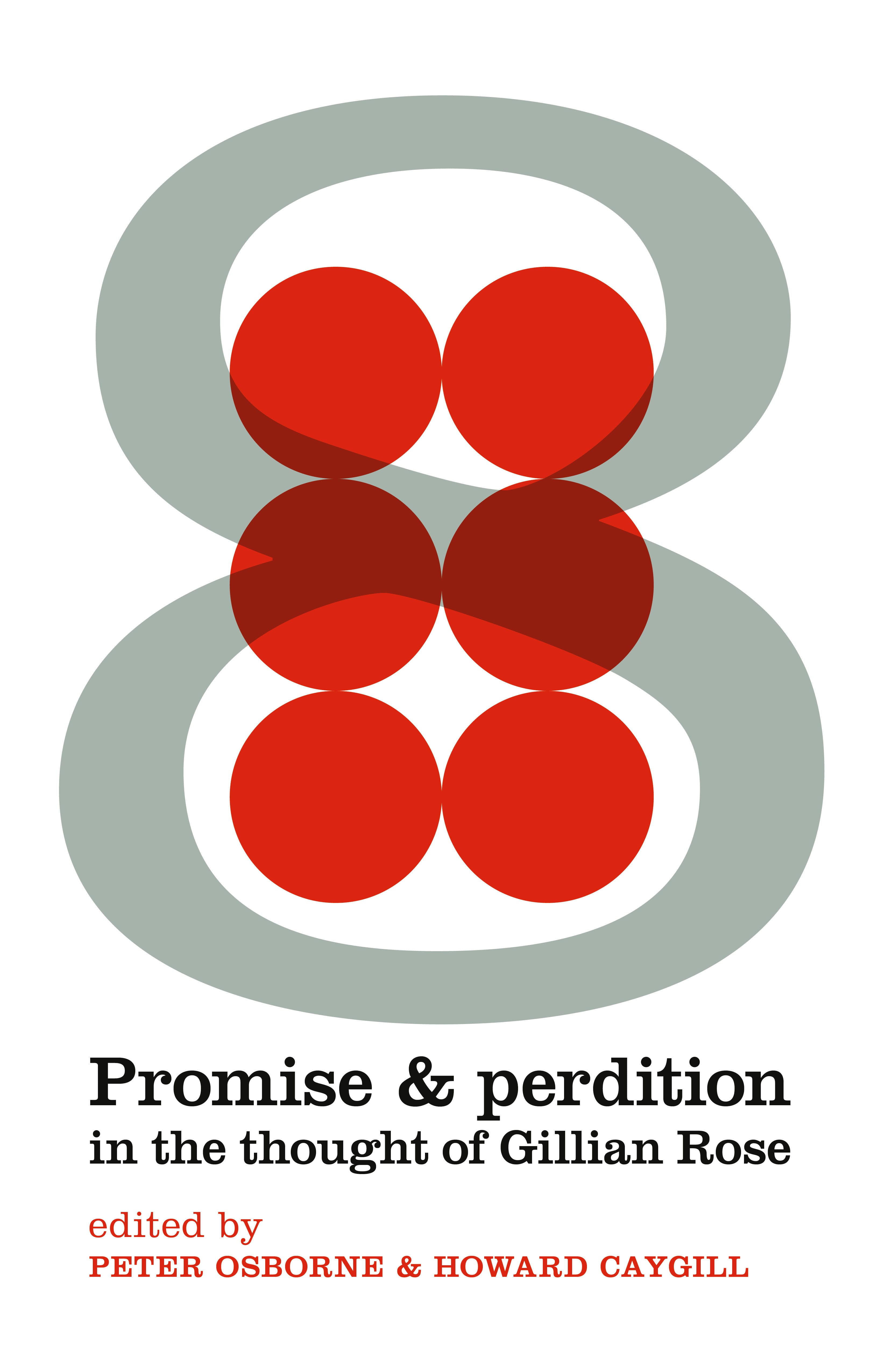
Promise & perdition in the thought of Gillian Rose
The essays collected in this eighth volume from CRMEP Books derive from a conference on the thought of the British sociologist and philosopher Gillian Rose, held at Swedenborg Hall in Bloomsbury, London, 18–19 June 2025. Interest in Rose’s wide-ranging body of critical work in the sociology and philosophy of modernity has grown significantly since her early death in 1995. In the wake of the publication of a Penguin Modern Classics edition of Rose’s Love’s Work (2024), along with some of her undergraduate lectures on critical theory from the University of Sussex at the end of the 1970s (Marxist Modernism, Verso, 2024), this thirty-year anniversary event set out to explore the play of promise and perdition – from which Love’s Work itself departed – across the full span of her writings.
Articles in this volume
Recordings
‘Becoming Tree: Artaud's Three Years in the Forest' (Howard Caygill)
A public lecture delivered at Central Saint Martins, University of the Arts London, 15 October 2026
‘Of Another Nihilism: On Jacques Rancière’s Distant Freedom: Essay on Chekhov’ (Catherine Malabou)
A talk delivered at Fyvie Hall, University of Westminster, 309 Regent's Street, London W1
'Foucault & the Woman in the Rorschach Dress' (Howard Caygill)
This is a recording of a lecture given at Fyvie Hall, University of Westminster, on 20 November 2025: ‘The Woman in the Rorschach Dress: Foucault at Münsterlingen'