
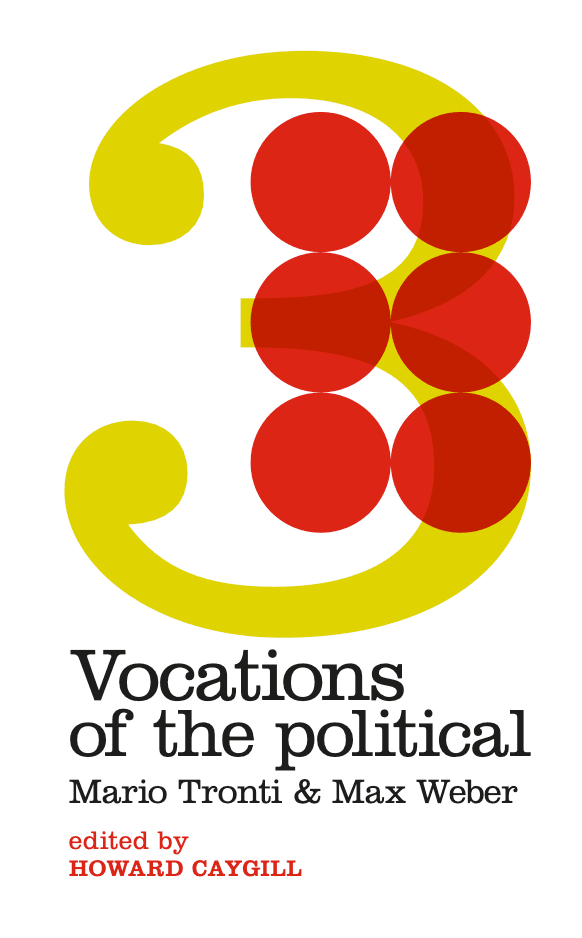
Vocations of the political: Mario Tronti & Max Weber
edited by Howard Caygill
2021
Following a recent and characteristically incisive intervention against the latest episode in the moral and political subsidence of the Italian left, Mario Tronti found himself being praised by an adversary as ‘the youngest, the most lucid, fresh and forward looking’ mind of the Italian left. Yet the terms of praise would be unfamiliar to most English-speaking readers of Tronti’s work: ‘a communist, but also Nietzschean … a utopian but also an operaista’. With the publication of a translation of the 1966 classic of twentieth-century political theory, Workers and Capital, in 2019, and The Weapon of Organisation in 2020, English-speaking readers are finally in a position to assess Tronti’s thought of the 1960s, but not thereafter. Tronti’s remarkable adventure of thought over the past half-century, with its utopian and Nietzschean inflections, remains largely a closed book to English-language readers. It was to address this situation that the Centre for Research in Modern European Philosophy at Kingston University decided to mark the conjunction of the publication of Workers and Capital and the centenary of Max Weber’s Politics as a Vocation (1919) with a conference on the theme of Tronti, Weber and their vocations of the political.