
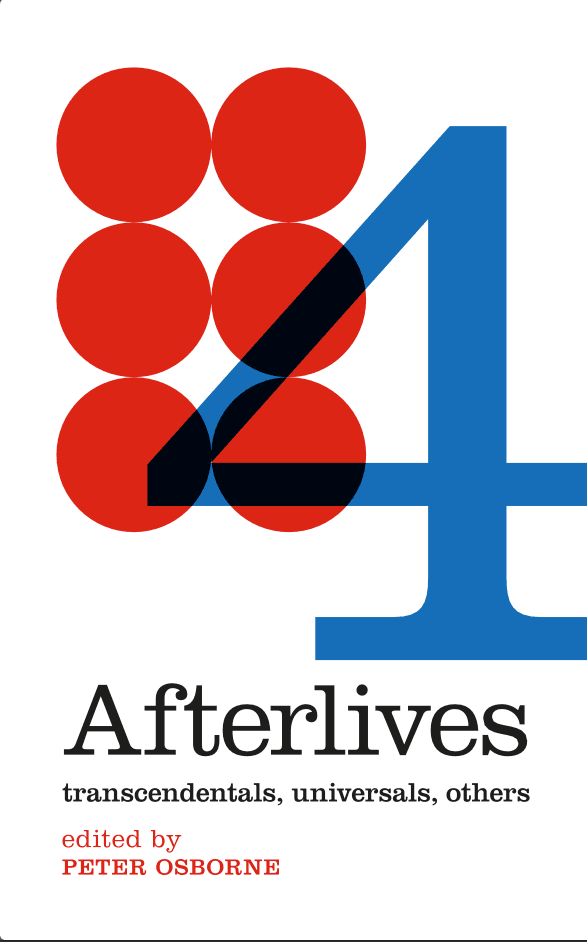
Afterlives: transcendentals, universals, others
edited by Peter Osborne
2022
The reception of the canonical texts and discourses of European philosophy – that is to say, their appropriation and re activation – has always been a politically as well as a hermeneutically contested activity. Such contestation takes place in the piecemeal manner of disputes over particular texts and authorships, in the broader field of the construction of ‘the tradition’ (struggles over canon formation and its boundaries) and, most fundamentally, through disagreements about the concept of tradition itself. Under conditions of growing global social interdependence – of which conflicts are less a negation than an effect – the self-enclosing ‘illusion of persistence’ that constitutes ‘tradition’ in any particular instance becomes ever more fragile. This is not only because the destructive, antiquating power of the new is renewed by each new cycle of crisis and accumulation, but because new forms of engagement with the standpoints of those living outside the tradition are forced on those within by the new dependencies. If all historical understanding derives from discontinuities between the ‘fore-history’ and the ‘after-history’ of historical circumstances, introduced into them by the present, then tradition, as a continuity of transmission (Überlieferung), is the very opposite of historical understanding. Transmission is itself here the catastrophe – the reproduction of the present in the image of the past.